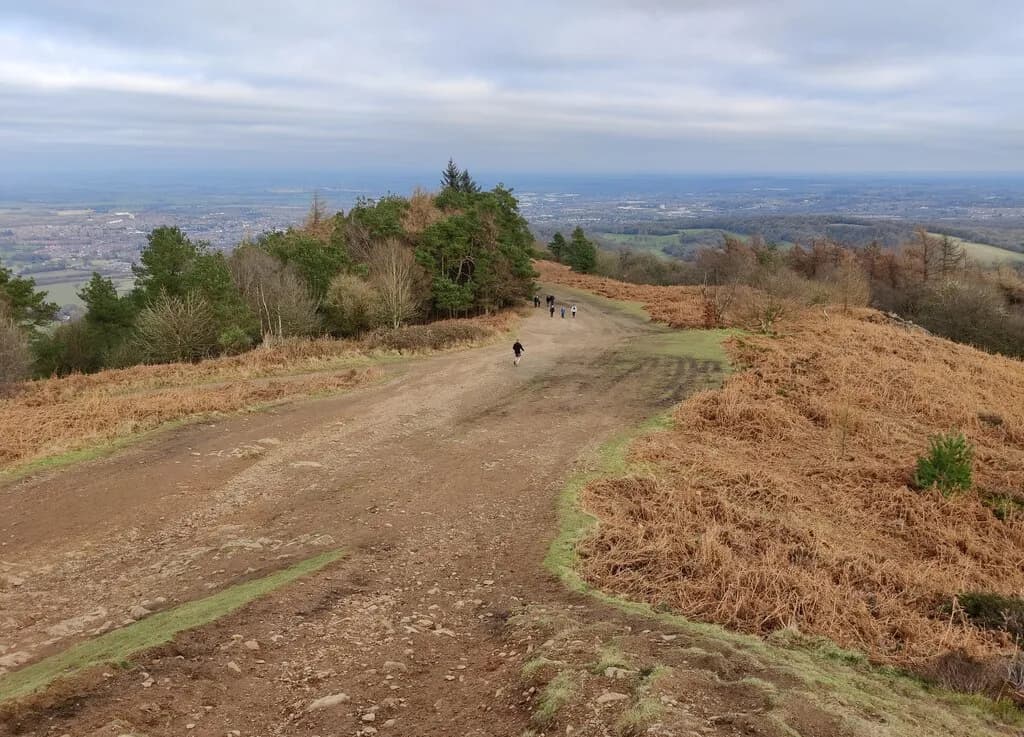
Rising 407 metres above the Shropshire plain just five miles west of Telford, The Wrekin is far more than a convenient landmark for motorway travellers. This solitary hill carries within its ancient volcanic rock nearly 700 million years of geological history, 2,000 years of human habitation, and a cultural significance so profound that it has become synonymous with Shropshire itself.
A Fortress Carved from Fire
The Wrekin's dramatic profile owes its existence to the violent tectonic forces of the Precambrian era. Around 680 million years ago, volcanic activity along an ancient island arc, similar to modern Japan, deposited successive layers of lava flows, rhyolites, tuffs, and agglomerates. These Uriconian Volcanics, though not from a volcano proper, nonetheless created a geological foundation that would prove remarkably durable.
Dolerite dykes later intruded around 563 million years ago, followed by granophyre formations approximately 560 million years ago. This complex geological heritage has produced a hill that dominates the surrounding landscape with a prominence of 298 metres, earning it recognition as a Marilyn, one of Britain's significant hills.
The Cornovii Capital
Long before the Romans marched into Britain, The Wrekin served as the political and military centre of the Cornovii tribe. An Iron Age hillfort covering nearly eight hectares crowned the summit, making it one of the most substantial prehistoric strongholds in the region. Archaeological evidence suggests this was not merely a defensive position but the tribal capital, the administrative heart of Cornovii territory.
That prominence made it a target. In AD 47, Roman invaders assaulted the hillfort, set it ablaze, and forcibly relocated the defeated tribe to Wroxeter (Viroconium Cornoviorum). The new settlement would grow into the fourth largest city in Roman Britain, housing over 15,000 people at its peak. Yet the Wrekin remained visible on the horizon, a persistent reminder of what had been lost.
Legends Etched in Stone
The hill's mythological significance runs equally deep. According to local folklore, a giant named Gwendol Wrekin ap Shenkin ap Mynyddmawr once attempted to flood Shrewsbury by dumping earth into the River Severn. A cunning cobbler tricked the giant by showing his worn-out shoes, claiming he had walked from Shrewsbury and exhausted his footwear on the journey. Convinced the town lay impossibly far away, the giant abandoned his plan and dumped his spadeful of earth where The Wrekin now stands, then scraped his boots to create neighbouring Ercall Hill.
This tale reflects a broader truth: The Wrekin has embedded itself so deeply into local consciousness that it has generated its own linguistic heritage. "All around the Wrekin" remains a common Shropshire expression meaning "the long way round." The traditional county toast, "To all friends around the Wrekin," acknowledges the hill as a unifying presence. Local weather lore holds that "if you can see the Wrekin, it's going to rain; if you can't see the Wrekin, it's already raining."
Near the summit, a narrow split between two rocks known as the Needle's Eye carries its own tradition: no one can claim to be a true Salopian unless they have squeezed through it.
Literary Landscapes
The Wrekin's evocative silhouette has inspired writers for generations. A.E. Housman immortalised it in his 1896 collection A Shropshire Lad, writing in Poem XXXI of how "His forest fleece the Wrekin heaves." Edward Lear included the hill in his Book of Nonsense with a limerick beginning "There was an Old Man of the Wrekin."
P.G. Wodehouse made the hill visible from his fictional Blandings Castle in A Pelican at Blandings (1969). Perhaps most intriguingly, J.R.R. Tolkien, during his time living in Penkridge, walked on The Wrekin and later claimed it provided inspiration for the landscapes of Middle Earth.
Modern popular culture continues the tradition. The 2020 video game Assassin's Creed Valhalla features "The Wroeken," while Christian Bale referenced the hill in the 2019 film Le Mans '66.
The Summit Today
For modern visitors approaching from Telford via the M54, Junction 7 provides the final exit before the A5 continues toward Shrewsbury. A car park at Forest Glen, nestled between The Wrekin and Ercall Hill, serves as the starting point for the well-trodden but steep ascent.
The summit rewards effort with a 360-degree panorama that, on clear days, extends to the Forest of Bowland in Lancashire, Manchester's Beetham Tower, Winter Hill, and Cleeve Hill in Gloucestershire. The River Severn winds toward Ironbridge in the south-east. One notable absence: despite occasional claims, Snowdon remains hidden behind Cadair Berwyn.
A trig point and toposcope mark the summit, alongside the Wrekin transmitting station whose red beacon pulses through the night. The beacon originally served as an aircraft warning during the Second World War, was decommissioned in the 1960s, then reinstalled for the Millennium celebrations in 2000.
In October 2022, a new artwork titled "The Sky Begins at My Feet" was unveiled for the Platinum Jubilee. Created by Sharon Griffin from stoneware clay tiles bearing relief portraits of seven local heroes, the piece adds a contemporary layer to the hill's accumulated heritage.
Conservation and Community
The Wrekin forms part of the Shropshire Hills Area of Outstanding Natural Beauty, specifically its northern salient. The Raby Estate, headed by Lord Barnard, owns the freehold, while the Shropshire Wildlife Trust manages nature reserves in the area. Parking fees collected from visitors fund ongoing conservation work.
That stewardship faces challenges. The Trust has reported crackdowns on fly-tipping and works to balance public access with environmental protection. In 1981, school pupils and adults held hands to surround the hill at its base, an event called "Hands around the Wrekin" that demonstrated the community's deep attachment to this landscape. The hill remains, as one BBC Shropshire feature described it, "one of Shropshire's most potent symbols," standing alongside the Iron Bridge as an emblem of the county's identity.
For Telford residents and Shropshire natives alike, The Wrekin represents more than scenery. It signals "almost home" to returning travellers. It marks the boundary between the urban development of the new town and the ancient landscapes beyond. It connects the industrial heritage of Ironbridge with the prehistoric settlement of Wroxeter, bridging millennia of human history in a single view.
From volcanic island arc to Iron Age fortress, from Roman conquest to modern conservation, The Wrekin has witnessed and shaped Shropshire's story. That 407-metre mound of ancient rock continues to define the county's soul.